 "A king executed, an ex-prince arrested: When UK royals found themselves on the wrong side of the law")
For centuries, British royal authority once stood above courts and parliaments, with power enforced through dynastic struggle, warfare and, at times, execution.
In the modern constitutional era, members of the royal family have increasingly been subject to the same legal processes as other citizens.
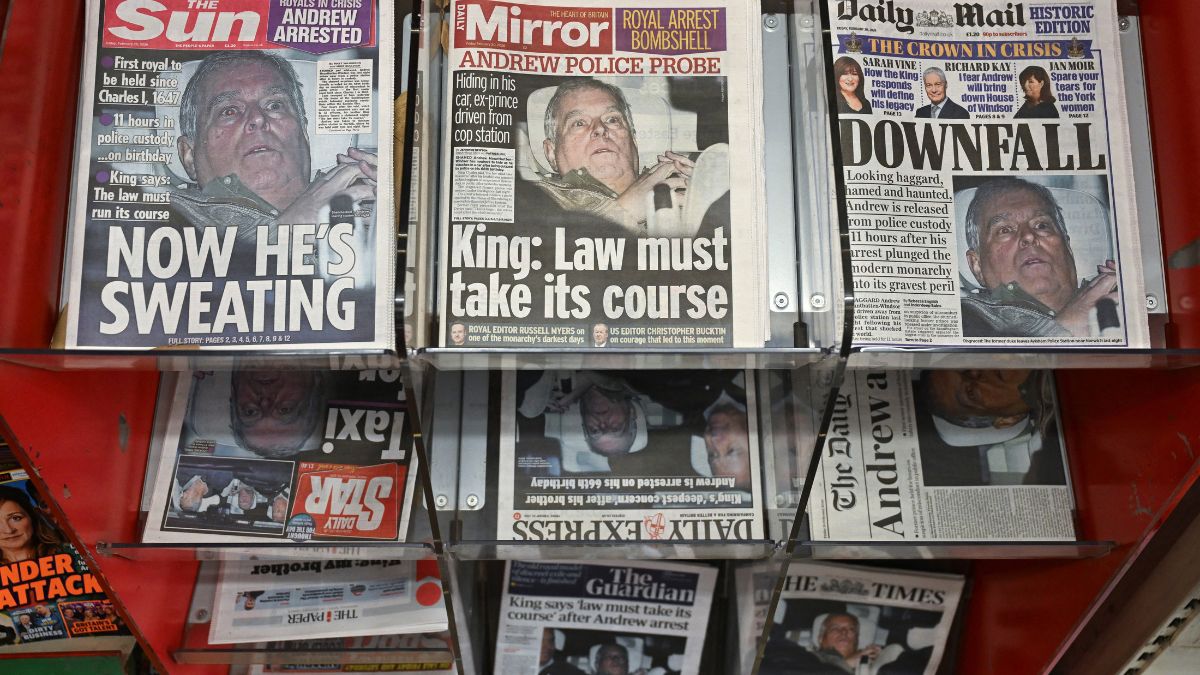
On Thursday, Andrew Mountbatten-Windsor was arrested by British police on suspicion of misconduct in public office.
The suspicion centred on allegations that, while serving as the British government’s Special Representative for Trade and Investment, Andrew had passed confidential official documents to the disgraced financier and sex-offender Jeffrey Epstein.
Following his detention, police carried out searches at multiple properties associated with Andrew. Early on Friday, six unmarked police vehicles and around eight plain-clothed officers were seen arriving at Wood Farm on the Sandringham estate in Norfolk, eastern England.
Officers from Thames Valley Police also searched the mansion on the Windsor estate, west of London, where Andrew had previously lived before being compelled to vacate the property in the wake of earlier controversies connected to Epstein.
The last time a UK royal was arrested: Charles I
Charles I was captured by parliamentary forces in 1647 after the defeat of royalist armies in the English Civil War.
The conflict arose from deep constitutional disputes, including the king’s belief in the divine right of monarchs and his refusal to accept parliamentary authority over governance and religious policy in England and Scotland.
Charles was subsequently placed on trial in Westminster Hall in January 1649. He rejected the legitimacy of the court, arguing that no earthly tribunal possessed authority over a monarch whose power, in his view, derived directly from God.
Despite his objections, he was convicted of treason and tyranny.
On January 30, 1649, he was executed outside the Banqueting House in Whitehall, central London. He remains the only English monarch to have been formally put to death by the state following a judicial process.
His final words, spoken before the executioner carried out the sentence, were recorded as, “I go from a corruptible to an incorruptible crown, where no disturbance can be, no disturbance in the world.”
The execution of Charles I marked a decisive moment in British constitutional history, symbolising the end of an era in which monarchs could plausibly claim immunity from legal accountability.
Although the monarchy was later restored, the precedent established during the Civil War fundamentally altered the balance of power between crown and parliament.
Earlier and later centuries were also marked by lethal consequences for members of royal and noble families.
Figures such as Lady Jane Grey, Anne Boleyn, Mary Queen of Scots and Catherine Howard were arrested and executed on charges of treason during the Tudor and Stuart periods.
Edward VII and the baccarat scandal
King Edward VII, while still Prince of Wales and heir to Queen Victoria, became embroiled in the baccarat scandal of 1890.
The controversy arose from an illegal game of baccarat played at the residence of a wealthy English host.
One participant was accused of cheating, and when rumours circulated, he denied the allegation and accused others of spreading falsehoods. The dispute escalated into a legal battle, with accusations and counter-accusations aired publicly.
Edward appeared in court as a witness during the High Court proceedings. Although he was not accused of wrongdoing himself, the spectacle of the heir to the throne testifying in an illegal gambling case caused widespread embarrassment and damaged public perceptions of royal conduct.
The affair became emblematic of Victorian moral anxieties and remains one of the most famous courtroom episodes involving a senior royal.
The baccarat case also holds a peculiar place in legal history. Edward’s appearance as a witness meant that, for more than a century, no other member of the royal family would stand in the same courtroom until Prince Harry appeared there roughly 130 years later, reported The Guardian.
Traffic offences by Princess Anne, Zara Tindall & Prince Philip
The most frequent royal encounters with the justice system have often involved road traffic laws. Princess Anne accumulated a lengthy record of motoring offences over several decades.
At the age of 21, she received a written warning after being caught driving at speeds of up to 90 miles per hour on the M1 motorway.
Five years later, she was fined £40 at Alfreton magistrates’ court for travelling at 96 miles per hour in a 70-mile-per-hour zone in Derbyshire.
In 1990, she faced a sanction when she was banned from driving for a month and fined £150 at a magistrates’ court in Stow-on-the-Wold, Gloucestershire. This followed her admission to two speeding offences, for which she said she had been late for an engagement.
More than a decade later, in 2001, she was again penalised for exceeding the speed limit.
On that occasion, she was fined £400, ordered to pay £30 in costs and received five penalty points on her driving licence after being recorded at 93 miles per hour in a 70-mile-per-hour zone while driving her Bentley.
Her explanation was that she believed the police vehicle behind her was a royal escort.
Princess Anne’s legal difficulties were not confined to motoring. In 2002, she pleaded guilty to offences under the Dangerous Dogs Act after her three-year-old bull terrier, Dotty, bit two children in Windsor Great Park.
At Slough magistrates’ court, she was fined £500, ordered to pay £250 in compensation and £148 in costs. The conviction resulted in a criminal record, making her the first member of the current royal family to be convicted of a criminal offence.
Although Dotty was granted a stay of destruction, a contingent order was imposed, meaning the dog would face automatic destruction if it attacked again.
The pattern of traffic-related penalties extended to the next generation. Zara Tindall, Princess Anne’s daughter, was handed a driving ban in January 2020. The ban resulted from the accumulation of penalty points under the “totting up” system.
She already had nine points on her licence when she was recorded travelling at 91 miles per hour on the A417 in Gloucestershire in November 2019, a road with a 70-mile-per-hour limit. The additional four points triggered an automatic disqualification.
She was also fined £666 and ordered to pay costs and a victim surcharge of £151.
Another modern episode involved Prince Philip. In January 2019, while driving near the Sandringham estate in Norfolk, his Land Rover was struck by another vehicle as he pulled out onto the A149.
The collision caused his car to overturn. Philip, who was 97 at the time, emerged uninjured.
The driver and passenger of the other car were taken to hospital for treatment and later discharged. Both drivers were breath-tested, with negative results.
Following the incident, Philip surrendered his driving licence voluntarily. The Crown Prosecution Service decided not to pursue charges against him.
An investigation of then-Prince Charles
In 2021, the Daily Mail reported remarks by former Metropolitan Police commissioner John Stevens, who disclosed that then-Prince Charles had been interviewed as a witness in 2005 during the three-year investigation into the 1997 death of Diana, Princess of Wales.
The inquiry examined a note written by Diana in which she speculated that she might be killed to enable Charles to marry their sons’ former nanny, amid false rumours of an affair at the time.
Stevens stated that Charles was not treated as a suspect and that investigators found no evidence to support the claim that he had any involvement in Diana’s death.
British royal household not new to scandals
Earlier centuries were filled with scandal that, while not always resulting in prosecution, deeply affected public perceptions of royal morality, reported The Telegraph.
In 1769, Lord Grosvenor brought a civil action against the Duke of Cumberland, the brother of King George III, after a servant allegedly discovered the duke with Lady Henrietta Grosvenor at a hotel in St Albans.
The trial attracted national attention when correspondence between the lovers was published in court reports. A jury awarded Lord Grosvenor £10,000 in damages for harm to his marital interests, a substantial sum at the time.
In 1806, Caroline of Brunswick faced accusations of having borne a child outside marriage. After her estranged husband ascended the throne as King George IV in 1820, he sought to divorce her, despite already being illegally married to Maria Fitzherbert.
The so-called Delicate Investigation failed to substantiate the rumours against Caroline, yet the controversy fractured the royal household. She was barred from attending her husband’s coronation in 1821 and died three weeks later.
Royal intrigue also fuelled darker rumours. In 1810, following the death of a valet named Joseph Sellis, speculation spread about the possible involvement of Ernest Augustus, one of George III’s sons.
Sellis was found with his throat cut after Ernest Augustus was reportedly attacked with a sword while asleep at St James’s Palace.
Although Sellis’s wound was deemed self-inflicted, the extreme nature of the injury and the circumstances of the death prompted persistent gossip within aristocratic circles.
The late 19th century saw the monarchy embroiled in the Cleveland Street Affair of 1889, when rumours circulated that the Duke of Clarence, eldest son of Edward VII, had frequented a male brothel near London’s Euston station.
Detectives uncovered the brothel, which was known to have been patronised by aristocrats. The Duke of Clarence, nicknamed for his flamboyant style of dress, was rumoured by some biographers to be bisexual.
As legal proceedings loomed, he was sent on an extended tour of India. He died of pneumonia three years later, before any definitive evidence emerged.
These episodes, though varying widely in credibility and outcome, contributed to a long tradition of scandal surrounding the British royal household.
What next for Andrew
Andrew was held by police for more than 10 hours before being released but no criminal charge has been brought against him yet.
Andrew has consistently denied wrongdoing in relation to Epstein and has said he regretted maintaining a relationship with him. Epstein, who was convicted in 2008 of soliciting prostitution from a minor, later died by suicide in 2019.
Despite Andrew’s denials, millions of documents released by the US government indicated that he had continued to associate with Epstein after the 2008 conviction.
Those files further suggested that Andrew had shared British government material with Epstein, including reports concerning investment opportunities in Afghanistan and assessments relating to Vietnam, Singapore and other countries he visited in his capacity as a trade envoy.
Misconduct in public office is a common law offence in England and Wales and carries a potential maximum penalty of life imprisonment.
Such cases are tried in the Crown Court, which handles the most serious criminal matters.
The constitutional implications were also notable. Andrew is eighth in line to the throne, making his detention historically exceptional. No senior member of the royal family had been arrested in Britain in modern times.
Responding publicly, King Charles III said he had learned of his brother’s arrest with “deepest concern”. He added, “Let me state clearly: the law must take its course. What now follows is the full, fair and proper process by which this issue is investigated in the appropriate manner and by the appropriate authorities.”
The latest developments occurred within an already strained relationship between the monarch and his younger brother.
With inputs from agencies


 "Iran War News Live: Azerbaijan withdraws envoys from Iran after drone strike on its airport")
 "'Hopeful not confident': Finnish President on a peace deal between Russia and Ukraine")
 "Decision to attack Iran taken after Modi had left the shores, says Israeli foreign minister")
 "Why US has given India a 30-day waiver to buy Russian oil")
 "Iran War News Live: Azerbaijan withdraws envoys from Iran after drone strike on its airport")
 "'Hopeful not confident': Finnish President on a peace deal between Russia and Ukraine")
 "Decision to attack Iran taken after Modi had left the shores, says Israeli foreign minister")
 "Why US has given India a 30-day waiver to buy Russian oil")