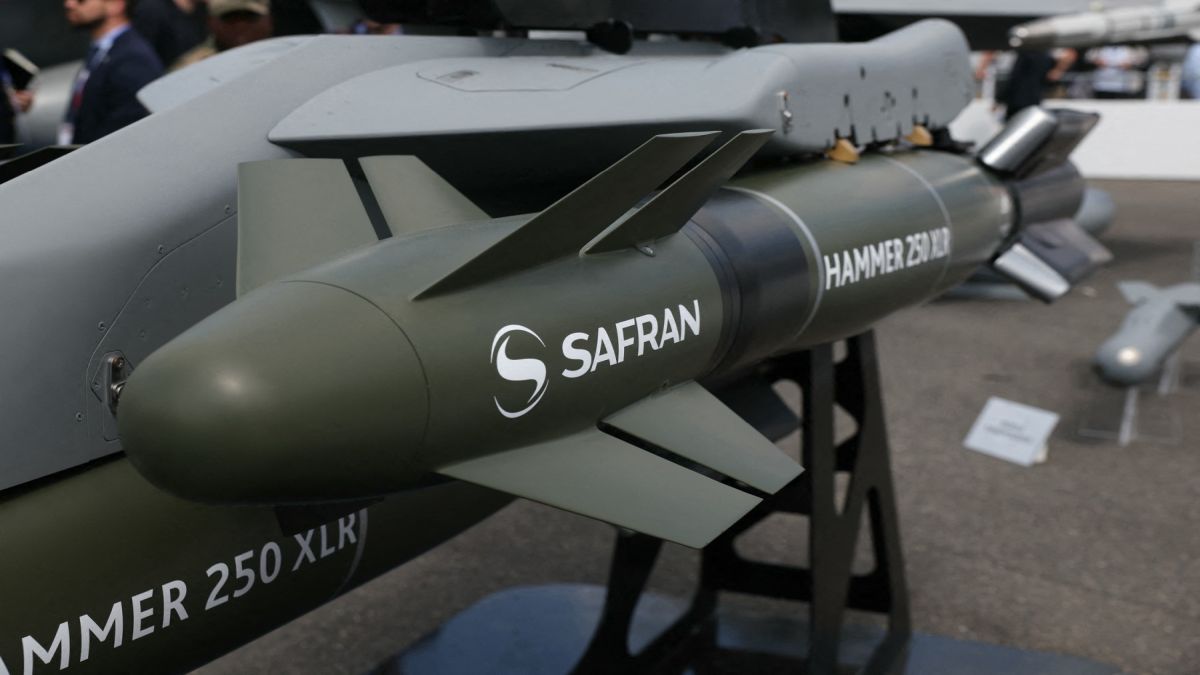
 "What are Hammer missiles, French ‘smart’ weapons system that will now be made in India?")
The India-France partnership will further deepen as Prime Minister Narendra Modi hosts French President Emmanuel Macron in Mumbai today (February 17). Defence and Artificial Intelligence (AI) are expected to feature prominently in talks between the two leaders.
Interestingly, while this is French President Macron’s fourth visit to India, it is his first visit to Mumbai. According to the itinerary, Modi and Macron will hold bilateral engagements at Lok Bhavan in the financial capital at 3.15 pm. Later, around 5.15 pm, the two will inaugurate the India-France Year of Innovation 2026 and address a gathering of business leaders, start-ups, researchers and other innovators from both countries. After the Mumbai engagements, French President Macron, accompanied by his wife, Brigitte Macron, will travel to New Delhi to attend the India AI Impact Summit 2026.
While a lot of attention has been given to the expected Rafale deal between India and France, the two countries are also likely to sign an MoU for the joint production of Hammer missiles.
Ahead of this signing, here’s a simple guide to these weapons and why they are important to India.
Hammer missiles, explained
Hammer stands for Highly Agile Modular Munition Extended Range. In technical terms, it is more popularly known by its French name AASM Hammer (Armement Air-Sol Modulaire).
Developed by France’s Safran Electronics & Defence, the Hammer is not a single missile; instead it’s kit that converts standard unguided (“dumb”) bomb bodies into smart precision-guided munitions. The Hammer system has two core components; first, is a nose-mounted guidance section that determines navigation and targeting, and the second is a tail-mounted range extension kit with a solid-fuel rocket booster and manoeuvrable winglets.
The weapon was first displayed publicly in 2007 at the Paris Air Show under the name AASM (Armement Air-Sol Modulaire). In 2011, it was renamed Hammer and is categorised as a medium-range air-to-ground weapon.
Quick Reads
View AllAlso known as a glide bomb, Hammer precision-guided munitions have a range of up to 70 kilometres and can be fitted to standard bombs of 250 kg, 500 kg, 1,000 kg weights.
The Hammer weapons system are known for its high accuracy and modular design, making it adaptable for multiple platforms. Working on the fire-and forget principle, it has been found to be effective in mountainous regions as well as heavily protected bunkers. The system can engage both stationary and moving targets and uses advanced navigation technology to minimise the chances of missing.
Because of its modular design, Hammer can be tailored for both close air support (CAS) and deep-strike operations, making it very flexible. The controlled-angle-of-impact capability, thanks to the guidance kit, allows for optimised glancing or penetrating strikes.
The Hammer weapons system was kept out of the 2016 contract for 36 Rafale fighter jets and the weapons package due to its cost.
India’s use of Hammer weapons system
The capabilities of the Hammer weapons system were on display when India carried out Operation Sindoor last May in retaliation to the Pahalgam terror attack. Twenty-one terror camps across nine locations were hit as part of the operation.
Among the many weapons deployed by India during Operation Sindoor were the Hammer weapons system. The usage of these weapons systems made the strikes incredibly effective and largely a success against terror infrastructure in Pakistan including the headquarters of Jaish-e-Mohammed and Lashkar-e-Taiba.
According to Indian military officials, owing to the Hammer guided munition being fully autonomous and completely unaffected by jamming made it the perfect choice to penetrate fortified structures, such as the terrorist targets in Pakistan.
Now, France’s Hammer to be ‘made in India’
Today (February 17) as Macron and Modi meet in Mumbai, an MoU will be signed between Bharat Electronics Limited (BEL) and Safran Electronics and Defence (SED) to form a private limited company, likely to be located in Pune, for the indigenous production of Hammer missiles mounted on fighter jets like Rafale.
This development came after BEL informed the stock exchange about the proposed JV, which it said will operate a “Centre of Excellence,” acting as a technology and teaming partner for the manufacturing, supply, maintenance and repair of the Guidance Kit (GK) of Hammer weapon system.
The Hammers weapons system created by the JV will be used by the Rafale-M for the Indian Navy. Mutually, the JV can decide to sell the missiles to other users within the country. According to a report in The Print, the indigenisation level will progressively increase up to 60 per cent with key sub-assemblies, electronics and mechanical parts being manufactured locally.
For India, this is a major push in the ‘Make in India' efforts. This is expected to reduce reliance on overseas suppliers and improve turnaround times for India’s Armed Forces.
Rafale and more… Other defence deals in the spotlight
Besides the deal for the Hammer weapons system, a potential multibillion-dollar deal for 114 additional Dassault Rafale fighter jets is also on the table when Macron and Modi meet for discussions today.
Moreover, while Macron meets Modi in Mumbai, Defence Minister Rajnath Singh and his French counterpart Catherine Vautrin will participate in the sixth India-France Annual Defence Dialogue in Bengaluru. At this meet, they will witness the virtual inauguration of the H125 Light Utility Helicopter Final Assembly of Tata Airbus.
Over the years, Paris has emerged as a trusted supplier of military hardware ranging from Mirage-2000 and Rafale combat jets, Scorpene submarines, Alize anti-submarine aircraft, Milan anti tank missiles, air surveillance radar and engines for Dhruv advanced light weight helicopters, manufactured by Hindustan Aeronautics Limited.
With inputs from agencies

 "Iran War News Live: Azerbaijan withdraws envoys from Iran after drone strike on its airport")
 "'Hopeful not confident': Finnish President on a peace deal between Russia and Ukraine")
 "Decision to attack Iran taken after Modi had left the shores, says Israeli foreign minister")
 "Why US has given India a 30-day waiver to buy Russian oil")
 "Iran War News Live: Azerbaijan withdraws envoys from Iran after drone strike on its airport")
 "'Hopeful not confident': Finnish President on a peace deal between Russia and Ukraine")
 "Decision to attack Iran taken after Modi had left the shores, says Israeli foreign minister")
 "Why US has given India a 30-day waiver to buy Russian oil")