 "India joins US-led Pax Silica: Why this tech alliance matters")
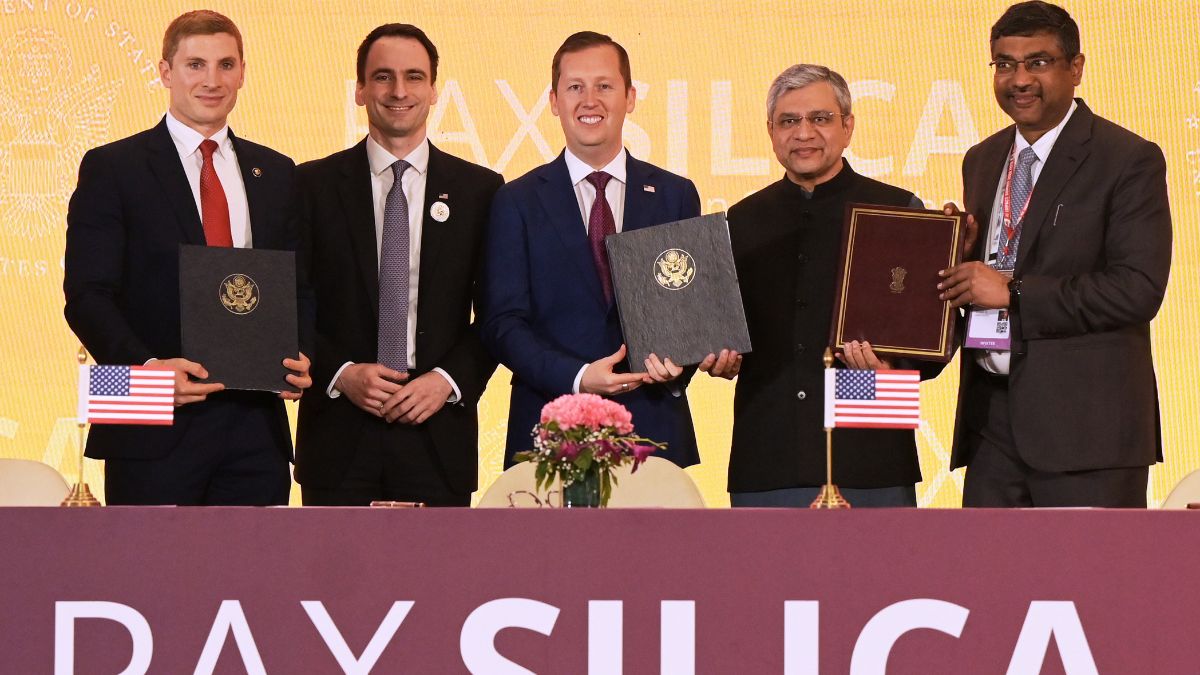
India has joined the United States-led Pax Silica initiative to secure AI and tech supply chains. The signing ceremony was held on the sidelines of the India AI Impact Summit at Bharat Mandapam in New Delhi on Friday (February 20).
Union Minister Ashwini Vaishnaw, US Under Secretary of State for Economic Affairs Jacob Helberg and US envoy to India Sergio Gor attended the ceremony. The development comes a month after Gor announced that India would be invited to join Pax Silica.
Let’s take a closer look.
What is Pax Silica?
Pax Silica is a US-led initiative to secure the silicon supply chain, including critical minerals, semiconductors and artificial intelligence (AI).
The term combines the Latin word for peace and stability and silica, which is the compound that is refined into silicon — a key element in the production of computer chips.
The America-led coalition of countries aims to build a “secure, resilient, and innovation-driven ecosystem across the entire global technology supply chain—from critical minerals and energy inputs to advanced manufacturing, semiconductors, AI infrastructure, and logistics,” according to the US State Department.
Pax Silica is an international grouping to “unite the countries that host the world’s most advanced technology companies to unleash the economic potential of the new AI age.”
It plans to safeguard the silicon supply chain — from critical minerals and energy inputs to advanced manufacturing, semiconductors, AI infrastructure, and logistics.
The Pax Silica Declaration was signed at a summit held in the United States on December 12-13, 2025. The founding signatories included Japan, South Korea, Singapore, Australia and Israel.
Quick Reads
View AllIt also included guest contributions from the Organisation for Economic Co-operation and Development (OECD), the European Union (EU), Canada, and Taiwan. The United Arab Emirates (UAE) also attended the summit without formally joining.
At the time, the non-inclusion of India in the US-led initiative came as a surprise to many, triggering concerns that uncertainty about the trade deal was creating broader differences.
According to the US State Department, Pax Silica wants to bring “friendly and trusted” countries together to ensure that key technologies are safe, reliable, and not controlled by hostile players.
The initiative will also entail protecting sensitive technologies and critical infrastructure from undue access or control by “countries of concern” and building trusted technology ecosystems, including Information and Communication Technology (ICT) systems, fibre-optic cables, data centres, foundational models and applications.
“The initiative responds to growing demand from partners to deepen economic and technology cooperation with the United States and understanding that AI represents a transformative force for our long-term prosperity. Recognition that trustworthy systems are essential for safeguarding our mutual security and prosperity,” the US State Department said.
Why India joining Pax Silica matters
“India’s entry in Pax Silica is strategic," US Ambassador Gor said after New Delhi signed the Pax Silica declaration. He stressed that the framework would enable deeper collaboration between trusted partners in emerging technologies.
Gor said the initiative opens avenues for sharing secure and reliable AI capabilities, adding: “We can share trusted AI technology with partners like India."
#WATCH | Delhi: Pax Silica Declaration signed between India and the US, in the presence of Ashwini Vaishnaw, Union Minister for Electronics & Information Technology and Jacob Helberg, US Under Secretary of State for Economic Affairs pic.twitter.com/QyHkM2pebY
— ANI (@ANI) February 20, 2026
India’s entry in Pax Silica comes as the West seeks to counter China and reduce reliance on the Asian giant for critical minerals, chips, and AI infrastructure.
China has emerged as a key supplier of Rare Earth Elements (REEs) and can influence the global flow of these resources.
The West has grown sceptical of China’s dominance in the manufacturing supply chain, leading global multinational companies to opt for a China-plus-one strategy since Covid-19, noted Indian Express.
In recent years, China has restricted the flow of critical resources. In response to US President Donald Trump’s tariff policies, China last year suspended the export of REEs to the US and other countries. India, which heavily relies on China’s import of rare-earth magnets, had to bear the brunt of Beijing’s restrictions on medium and heavy rare earth-related products.
By joining the Pax Silica initiative, India could get a share of the manufacturing supply chain shift. While the South Asian country does not have a global-scale AI infrastructure currently, it will benefit from the possible investments and partnerships under the initiative, as per Indian Express.
This will give a boost to India’s late-start and growth in the semiconductor mission and the AI race.
“Pax Silica is really not about China, it is about America. We want to secure our supply chains,” Helberg, US undersecretary of State for economic affairs, told CNBC in an interview. “We view India as a partner to help de-risk and diversify those supply chains,” he added.
With inputs from agencies


 "Iran War News Live: Azerbaijan withdraws envoys from Iran after drone strike on its airport")
 "'Hopeful not confident': Finnish President on a peace deal between Russia and Ukraine")
 "Decision to attack Iran taken after Modi had left the shores, says Israeli foreign minister")
 "Why US has given India a 30-day waiver to buy Russian oil")
 "Iran War News Live: Azerbaijan withdraws envoys from Iran after drone strike on its airport")
 "'Hopeful not confident': Finnish President on a peace deal between Russia and Ukraine")
 "Decision to attack Iran taken after Modi had left the shores, says Israeli foreign minister")
 "Why US has given India a 30-day waiver to buy Russian oil")