 "Defence, tech, trade: What’s the agenda of PM Modi’s Israel visit?")
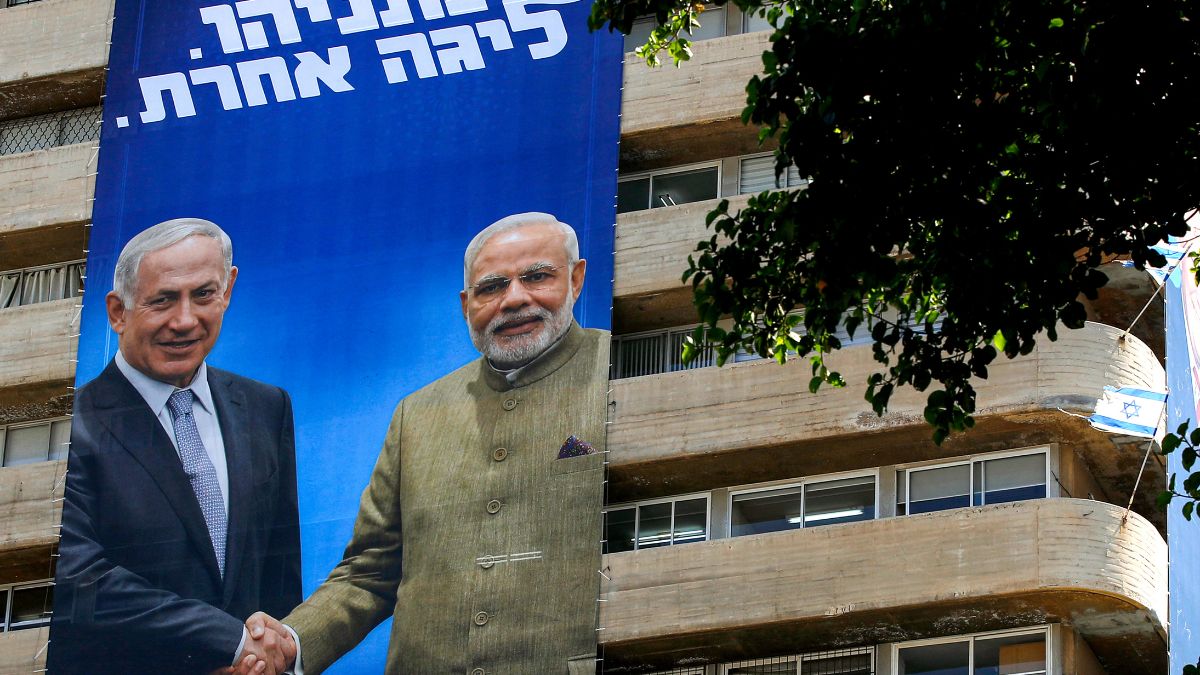
Prime Minister Narendra Modi has landed in Israel for a two-day visit, his second trip to the West Asian country since 2017. This comes as India and Israel’s ties have evolved in recent years.
The PM was accorded a red-carpet welcome at Tel Aviv’s Ben Gurion Airport; Israel’s Prime Minister Benjamin Netanyahu and wife, Sara, received Modi at the airport.
Modi will be in Israel as tensions roil West Asia, with a threat of the United States striking Iran looming large. Defence, trade and tech are expected to be the main features of the Indian leader’s visit.
We take a look.
Modi’s Israel visit
PM Narendra Modi will be on a state visit to Israel from February 25-26. He will hold talks with his Israeli counterpart, Benjamin Netanyahu.
I will be undertaking a State Visit to Israel today and tomorrow. Our nations share a robust and multifaceted Strategic Partnership. Ties have significantly strengthened in the last few years. I will be holding talks with PM Netanyahu, in which we will discuss ways to strengthen…
— Narendra Modi (@narendramodi) February 25, 2026
The two leaders will review the “significant progress made in India - Israel Strategic Partnership, and discuss further opportunities in various areas of cooperation, including science and technology, innovation, defence and security, agriculture, water management, trade and economy, and people-to-people exchanges,” according to the Ministry of External Affairs (MEA) statement.
Regional and global issues of mutual interest are also expected to come up during the discussions.
PM Modi will meet his Israeli counterpart Benjamin Netanyahu shortly after his arrival, and later in the day, he will address the Knesset (the Israeli Parliament) at 8 pm. In October 2015, the then-President Pranab Mukherjee had addressed the Israeli Parliament.
PM Modi will also visit a technology and innovation exhibit later this evening, before joining Netanyahu for a private dinner.
On Thursday, PM Modi will pay a visit to Yad Vashem, Israel’s official memorial, established in 1953, to commemorate the six million Jews murdered by the Nazis. He is also expected to call upon Israeli President Isaac Herzog and interact with the Indian community. PM Modi and Netanyahu will meet for delegation-level talks.
What’s the agenda?
Defence is expected to be the centrepiece of PM Modi’s visit to Israel.
The West Asian country is one of India’s biggest arms suppliers. New Delhi has been Israel’s largest defence buyer for years, accounting for 34 per cent of total sales between 2020 and 2024, according to the Stockholm International Peace Research Institute (SIPRI).
During the Indian leader’s trip, the two countries could hold deliberations on joint development projects in areas such as anti-ballistic missile defence systems, directed-energy laser weapons, long-range stand-off missiles and next-generation drones, as per Forbes India.
It reported that Israel has given a nod to $8.6 billion in arms deals with India in 2026.
There are reports that India and Israel could sign a defence framework during PM Modi’s visit. This would result in the opening of previously restricted areas of cooperation to India, including advanced air defence systems.
Israel could offer its cutting-edge laser-based air defence platform, known as Iron Beam, to India, reported the Israeli portal CTech by Calcalist.
“This is a significant transformation,” an official told Israeli media. “The framework increases flexibility for our defence establishments and allows both sides to rely on each other in times of need.”
There are also unverified reports that Israel has offered to supply its Golden Horizon air-launched ballistic missile to India.
India has intensified efforts to expand domestic defence manufacturing. Israel’s expertise in military technology will be an advantage for New Delhi as it promotes Make-in-India to bolster its defence sector.
As per Forbes India, the two sides could also sign agreements in various sectors such as technology, artificial intelligence (AI), agriculture, water management, security and trade.
Total merchandise trade stood at $3.62 billion in the financial year (FY) 2024-2025. PM Modi’s visit comes at a time when India and Israel have launched negotiations for a Free Trade Agreement (FTA).
India and Israel could establish a joint cybersecurity centre of excellence, further boosting cooperation in the defence and technology sectors.
“This visit represents a leap forward not only in defence but also across food security, agriculture, water, finance, and infrastructure,” Israel’s ambassador to India, Reuven Azar, was quoted as saying by local media.
Ahead of Modi’s visit, the Israeli government approved a $40 million plan to enhance cooperation with India in different sectors. It has decided to set up 10 new centres of excellence in India, increase academic exchange, and create joint programs in renewable energy, telemedicine, and infrastructure, reported CTech.
Modi and Netanyahu are likely to discuss the India-Middle-East-Europe Economic Corridor, of which Israel is also a part.
Before the Indian leader’s visit, the Israeli PM announced plans to build a network of allied nations — titled the Hexagon of Alliances — in or around West Asia to counter “radical adversaries”. This proposed grouping will bring together Israel, Greece, Cyprus, and several Arab countries, as well as India.
However, New Delhi will proceed with caution while considering Israel’s proposal to join the Hexagon of Alliances, whose main target seems to be Iran and its backed regional proxies, known as the Axis of Resistance.
India shares a friendly relationship with Iran and would be wary of being a part of any such alliance.
Why Modi’s Israel visit is important
PM Modi’s visit assumes significance as only a few leaders from the Global South have travelled to Israel since the October 7, 2023, attack on the West Asian country by Hamas militants, analysts said, as per Al Jazeera.
The MEA said the trip will “reaffirm the deep and long-standing strategic partnership between the two countries and will present an opportunity to review the common challenges as well as realign efforts towards achieving their shared vision for a robust partnership between two resilient democracies.”
The timing of Modi’s travel to Israel has also grabbed attention. He will be in the West Asian country just days after India, along with more than 100 other nations, condemned Israel’s expansion in the occupied West Bank.
India had strongly criticised the October 7 attack that led to Israel’s devastating war against Hamas in Gaza. New Delhi continues to support a two-state solution for Palestine.
With inputs from agencies

 "Iran War News Live: Azerbaijan withdraws envoys from Iran after drone strike on its airport")
 "'Hopeful not confident': Finnish President on a peace deal between Russia and Ukraine")
 "Decision to attack Iran taken after Modi had left the shores, says Israeli foreign minister")
 "Why US has given India a 30-day waiver to buy Russian oil")
 "Iran War News Live: Azerbaijan withdraws envoys from Iran after drone strike on its airport")
 "'Hopeful not confident': Finnish President on a peace deal between Russia and Ukraine")
 "Decision to attack Iran taken after Modi had left the shores, says Israeli foreign minister")
 "Why US has given India a 30-day waiver to buy Russian oil")