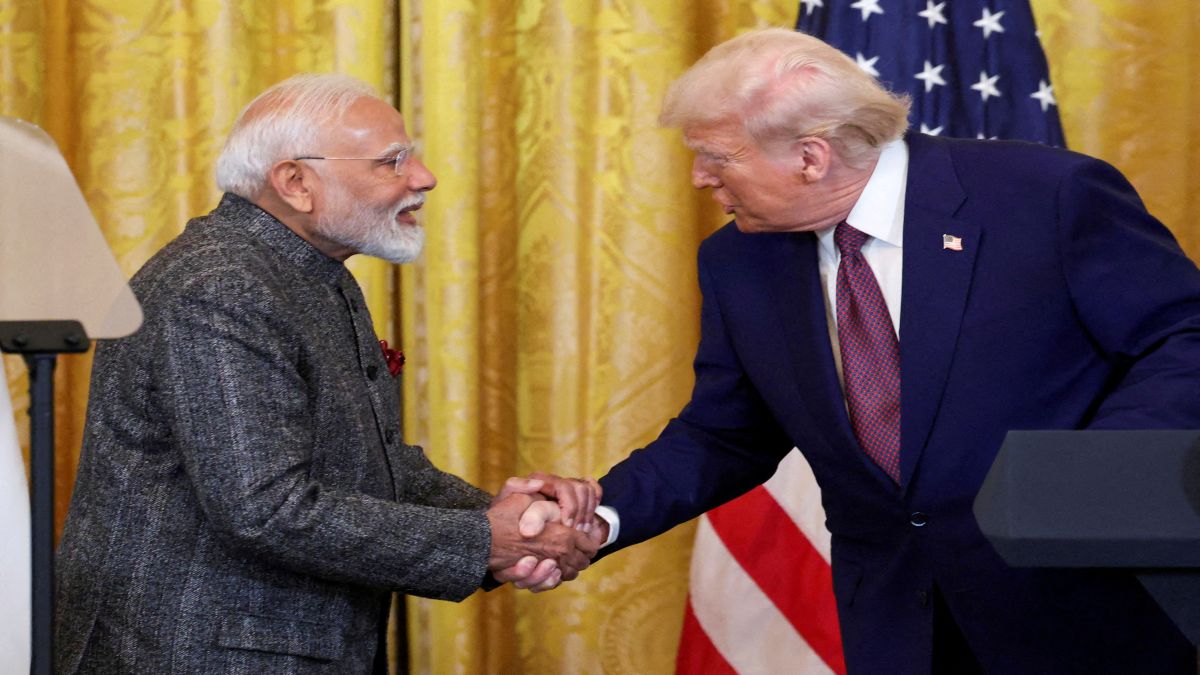
 "As new US tariffs come into effect today, how India could be at an advantage")
Tariff turmoil is back after the US supreme court decided to strike down Donald Trump’s emergency levies. Starting today (Tuesday), fresh tariffs on imported goods have come into effect, with the White House noting that the new levies, at 15 per cent, are justified as a means “to deal with the large and serious United States balance-of-payments deficits”.
Despite the US court’s order, Trump has doubled down on imposing tariffs on trading partners, and even warned countries against “playing games” by using the ruling to play hardball on trade commitments.
For many, this warning could have been aimed at India after New Delhi deferred a three-day meeting scheduled to begin on Monday (February 23) to discuss their interim trade deal that both sides agreed upon earlier this month.
Trump tariffs struck down by US supreme court
Last Friday (February 20), the US top court struck down President Donald Trump’s use of emergency powers to impose tariff rates of his choosing. For many, this was a stinging defeat for the American leader with major implications for the global economy.
In its 6-3 decision, the US supreme court upheld a lower court’s decision that Trump’s use of this 1977 law exceeded his authority. The justices ruled that the law at issue — the International Emergency Economic Powers Act, or IEEPA — did not grant Trump the power he claimed to impose tariffs.
The court’s decision provoked a furious reaction from Trump, who denounced the justices who ruled against him. “I’m ashamed of certain members of the court — absolutely ashamed — for not having the courage to do what’s right for our country,” said the US president.
He further added that “other alternatives” were available to him to pursue tariffs and announced a 10 per cent global tariff — which he then increased to 15 per cent — which has now come into effect. However, the new levies only last for 150 days unless extended by Congress and is widely seen as a bridge towards a more durable trade policy.
Trump’s warning against countries ‘playing games’
An irate Trump also issued a warning on Monday to countries against backing away from recently negotiated trade deals following the US supreme court’s decision.
In a series of posts on social media, the American president said that if they (the countries) did, he would hit them with much higher duties under different trade laws.
“Any country that wants to ‘play games’ with the ridiculous supreme court decision, especially those that have ‘ripped off’ the USA for years, and even decades, will be met with a much higher tariff, and worse, than that which they just recently agreed to. Buyer Beware!” Trump wrote on Truth Social.
He added that despite the court’s decision to invalidate his tariffs under the IEEPA, its decision affirmed his ability to use tariffs under other legal authorities “in a much more powerful and obnoxious way, with legal certainty, than the tariffs as initially used”.
While Trump didn’t name any country in his rant, many believe that it could have been targeted at India and the European Union.
That’s because the European Union signalled it would put a key trade agreement with Washington on hold. Lawmakers in the European Parliament said on Monday that they would freeze plans to approve a major trade deal with the US until there is greater clarity on how the court ruling affects tariff arrangements.
Also, India has delayed plans to send a trade delegation to Washington this week, aimed at firming up the interim trade deal. The delegation had been set to leave on Sunday for talks to finalise an interim trade deal, after both countries agreed on a framework for Washington to cut punitive tariffs of 25 per cent on some Indian exports linked to New Delhi’s Russian oil purchases. US tariffs on Indian goods were set to be cut to 18 per cent, with New Delhi agreeing to buy US items worth $500 billion over five years, ranging from energy supplies to aircraft and parts, precious metals, and technology products.
A source was quoted as telling Reuters, “The decision to defer the visit was taken after discussions between officials of the two countries. No new date for the visit has been decided.”
India set to gain
Following the US Supreme Court’s decision, US tariffs on India now stand at 10 per cent. That’s even below the agreed upon 18 per cent decided between the two nations in the interim trade deal. And this is why many believe that India is now at an advantage against the US, as it has lost its leveraging power. Emkay Global Financial Services in an economic note, said the ruling was “a positive development for India,” adding that the US had “lost immediate tariff leverage as a means to agree to favourable trade deals globally.”
According to a Bloomberg report, the US supreme court’s decision to strike down Trump’s emergency tariffs gives India more scope in negotiations over a trade deal. The news outlet added that while India isn’t considering backing away from the framework agreement, it will be able to seek safeguards to protect itself from similar legal or executive reversals in the future.
Others also point to the fact that India’s deal with the US is still under negotiation and the two countries have only reached a framework for an Interim Agreement. They pointed out clause 8 of the Framework for an Interim Agreement, which states, “In the event of any changes to the agreed upon tariffs of either country, the United States and India agree that the other country may modify its commitments.”
This clause will give India some room to wiggle to recalibrate the final details of the trade deal with the US. As the I_ndian Express_ reported, India can potentially invoke that specific clause to say that America’s commitment now stands “modified”. It also gives New Delhi the chance to revisit the other commitments before a final trade deal is signed.
Meanwhile, India’s Commerce Ministry said it was studying the implications of the ruling and Trump’s subsequent moves. “We have noted the US Supreme Court judgment on tariffs. President Trump has also addressed a press conference in that regard. Some steps have been announced by the US administration. We are studying all these developments for their implications,” it said.
While the future remains uncertain, it appears that India is at an advantage. It’s left to be seen how New Delhi leverages it into concrete gains.
With inputs from agencies


 "Iran War News Live: Azerbaijan withdraws envoys from Iran after drone strike on its airport")
 "'Hopeful not confident': Finnish President on a peace deal between Russia and Ukraine")
 "Decision to attack Iran taken after Modi had left the shores, says Israeli foreign minister")
 "Why US has given India a 30-day waiver to buy Russian oil")
 "Iran War News Live: Azerbaijan withdraws envoys from Iran after drone strike on its airport")
 "'Hopeful not confident': Finnish President on a peace deal between Russia and Ukraine")
 "Decision to attack Iran taken after Modi had left the shores, says Israeli foreign minister")
 "Why US has given India a 30-day waiver to buy Russian oil")