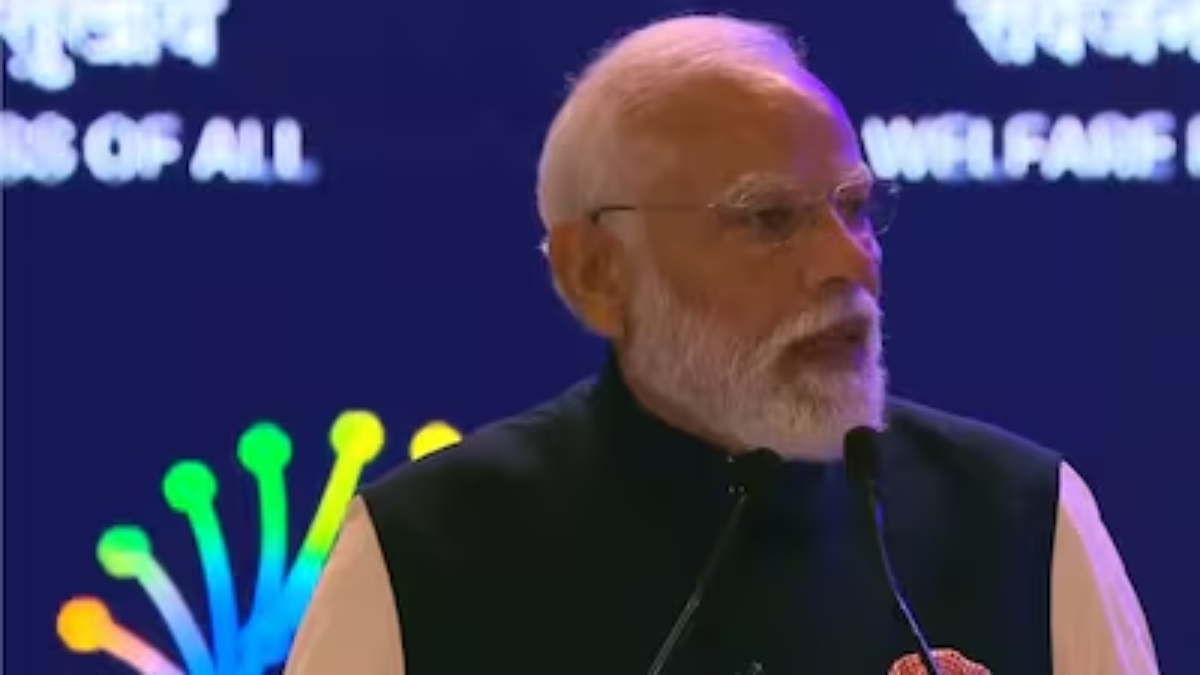
 "‘AI not a threat, India sees it as its destiny and future’: PM Modi outlines 'Manav' vision AI Impact Summit")
Addressing the AI Impact Summit in New Delhi on Thursday, Prime Minister Narendra Modi laid out a human-centric vision for the future of artificial intelligence, describing it as the ‘MANAV’ framework for AI governance. In his address, the prime minister raised concerns over child safety and called for the democratisation and inclusiveness of the rapidly emerging technology.
The prime minister stressed the approach to “make AI human-centric rather than AI-centric” as he presented the ‘MANAV’ framework, which focuses on ethics, accountability, data sovereignty, accessibility and legal validity. “AI is a transformative power. If directionless, it becomes a disruption; if the right direction is found, it becomes a solution. How to make AI from machine-centric to human-centric, how to make it sensitive and responsive, this is the basic objective of this Global AI Impact Summit,” PM Modi said at the summit.
“The theme of this summit clearly reflects the perspective from which India views AI. Welfare of all, the happiness of all. This is our benchmark,” he added. The prime minister insisted that humans should not be just data points for AI. “Welfare for all and happiness for all is our benchmark. Humans should not become mere data points or raw material for AI,” the Prime Minister said, asserting that there is a need to democratise AI and make it an inclusive model.
“We must democratise AI. It must become a tool for inclusion and empowerment, particularly for the Global South,” the Prime Minister furthered. He underscored, “We should provide AI with an open scope to evolve, but the command must remain in our hands”.
PM Modi’s MANAV Vision for AI
The prime minister laid down the MANAV framework, which is as follows:
M - Moral and Ethical Systems: Ethics and moral responsibilities to society should guide AI systems
A - Accountability: The governance and regulations must ensure accountability with transparent rules and oversight.
N - National Sovereignty: Data generated from one nation should belong to that nation and remain under its jurisdiction.
A - Accessible and Inclusive: AI systems should be accessible everywhere. It should be a multiplier and not a monopoly.
V - Valid and Legitimate: AI must be reliable and verifiable under the rule of law.
“This MANAV vision of India will become an important link for the welfare of humanity in the AI-based world of the 21st century,” the prime minister said in his address.
PM Modi raises concerns over child safety
In his Thursday address, the prime minister also raised concern over child safety dur to the penetration of AI. “We must become even more vigilant about children’s safety. The AI space should also be child-safe and guided in a family-friendly manner,” he said.
However, PM Modi maintained that ‘AI is not a threat’ to society. " Some people always talk about AI with fear, seeing it as a threat. Others see AI as an opportunity and a turning point. India sees AI as its destiny and its future… Three Indian companies have launched AI models and apps — this reflects the immense talent and potential of our youth. Any AI model that succeeds in India can be deployed globally,” he said.
Quick Reads
View AllThe prime minister concluded his address by emphasising that AI should be used for the common good. “Let us pledge to develop AI as a global common good. A crucial need today is to establish global standards. Deepfakes and fabricated content are destabilising the open society…In the digital world, content should also have authenticity labels so people know what’s real and what’s created with AI. As AI creates more text, images, and video, the industry increasingly needs watermarking and clear-source standards. Therefore, this trust must be built into the technology from the start,” he said.


 "Iran War News Live: Azerbaijan withdraws envoys from Iran after drone strike on its airport")
 "'Hopeful not confident': Finnish President on a peace deal between Russia and Ukraine")
 "Decision to attack Iran taken after Modi had left the shores, says Israeli foreign minister")
 "Why US has given India a 30-day waiver to buy Russian oil")
 "Iran War News Live: Azerbaijan withdraws envoys from Iran after drone strike on its airport")
 "'Hopeful not confident': Finnish President on a peace deal between Russia and Ukraine")
 "Decision to attack Iran taken after Modi had left the shores, says Israeli foreign minister")
 "Why US has given India a 30-day waiver to buy Russian oil")