 "Unitree Go2: The Chinese AI robot dog that caused a stir at India’s AI Impact Summit")
It looked futuristic, it walked like a dog, and it caused an uproar at one of India’s biggest technology events.
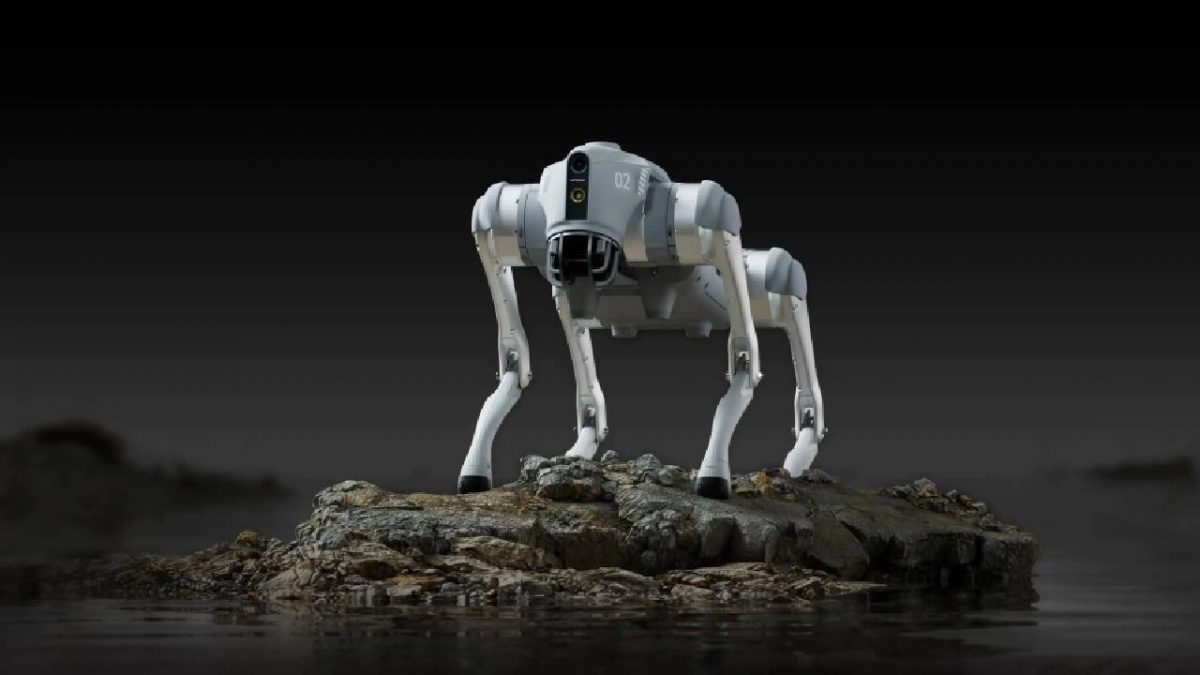
The AI-powered robot that recently grabbed attention at the India AI Impact Summit wasn’t an Indian invention after all, it was the Unitree Go2, a Chinese-made quadruped robot from Unitree Robotics.
Rebranded as “Orion” during the event, the robot’s surprise appearance triggered online debates and sent netizens on a hunt to uncover its real identity, price, and capabilities.
Unitree Go2: Launch, features and price
The Unitree Go2 isn’t new to the world of robotics. Officially launched on July 12, 2023, it’s the second-generation quadruped robot from Unitree Robotics, following the earlier Go1 model that debuted in 2021.
The company positioned the Go2 as a more intelligent, consumer-friendly robot dog, equipped with what it calls “embodied AI”, a blend of GPT-powered intelligence, advanced obstacle detection, and precise navigation.
Unitree markets the Go2 as ideal for research institutions, developers, and even hobbyists who want a taste of robotics without spending a fortune. The robot is capable of walking, running, stretching, and dancing. It can even climb stairs in dedicated “Climb” and “Descend” modes. It’s designed for both indoor and outdoor environments, using its sensors to move around with impressive agility and stability.
Its price also turned heads: globally, the Go2 Air variant starts at around US$1,600 (roughly Rs 1.45 lakh), while the Go2 Pro sells for about US$2,800 (Rs 2.3–2.5 lakh). Compared to industrial-grade models like Unitree’s B1 and B2, which cost close to US$100,000, the Go2 is practically a bargain in the robotics world.
Quick Reads
View AllPowering up with “embodied AI”
The Go2’s appeal lies not just in its affordability but also in its technology. Built with an aluminium alloy and engineering plastic body, the 16 kg robot houses an 8-core processor, an 8,000mAh removable battery, and a wide-angle 3D LiDAR sensor. Its LiDAR and 720p camera work together to map surroundings in real time, detect obstacles, and ensure smooth navigation.
The higher-end Go2 Pro adds 4D LiDAR for improved environmental awareness and enhanced movement precision. It connects via Wi-Fi 6 and Bluetooth, allowing remote control through a smartphone app. The robot can run for up to two hours on a single charge and reach speeds of nearly 13 km/h, giving it both stamina and speed.
At the Consumer Electronics Show (CES) 2025, Unitree unveiled an upgraded version called the Go2-W, a hybrid variant that combines wheels with legs for even faster and smoother motion. This addition has further strengthened Unitree’s position in the growing consumer robotics segment.
Why the buzz in India?
The Go2 hit Indian headlines after its appearance at the AI Impact Summit, where it was reportedly showcased under a different name, “Orion.” The controversy led to the removal of Galgotias University from the summit, after organisers discovered the robot wasn’t a local innovation but a rebranded import from China.
While the episode caused a stir, it also thrust the Unitree Go2 into the national spotlight, with thousands searching online for its price and origins.
Beyond the drama, the robot’s sudden fame reflects a larger truth, AI-powered machines like the Go2 are no longer confined to research labs or defence projects. They’re entering classrooms, workshops, and even homes.
As robotics and artificial intelligence continue to merge, the Go2 stands as a prime example of how affordable, AI-enabled machines are reshaping human-robot interaction.
Whether it’s mistaken identity or marketing misstep, the Unitree Go2 has achieved what every innovation dreams of: global attention, and a viral moment that made the world look twice at the future of AI on four legs.


 "Iran War News Live: Azerbaijan withdraws envoys from Iran after drone strike on its airport")
 "'Hopeful not confident': Finnish President on a peace deal between Russia and Ukraine")
 "Decision to attack Iran taken after Modi had left the shores, says Israeli foreign minister")
 "Why US has given India a 30-day waiver to buy Russian oil")
 "Iran War News Live: Azerbaijan withdraws envoys from Iran after drone strike on its airport")
 "'Hopeful not confident': Finnish President on a peace deal between Russia and Ukraine")
 "Decision to attack Iran taken after Modi had left the shores, says Israeli foreign minister")
 "Why US has given India a 30-day waiver to buy Russian oil")