 "4 ways, 4 years of Russia-Ukraine war changed International order forever")
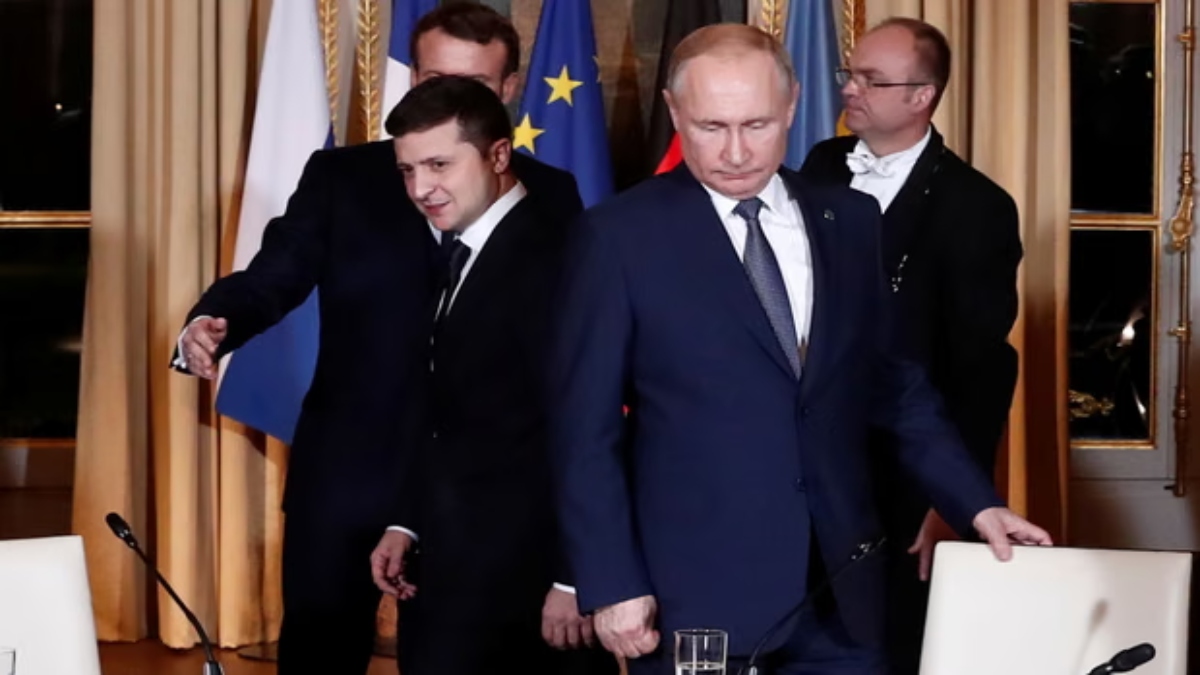
On February 24, 2022, Russia rocked the international order after it started to invade the eastern flank of Ukraine. The world was rattled, with Ukraine attempting to resist to the best of its capabilities. It has been 4 years since then. The war between the two nations is still ongoing. Countless people have been killed on both sides of the border, and the international order has been in a state of disarray since then.
When historians look back at the biggest conflict in the modern era, they will not only witness the frequent redrawing of borders and the brutal killings, but they will also see how the conflict permanently altered the nature of modern warfare and the decades-old alliances.
It will showcase how a small country like Ukraine can hold its ground against a mighty country like Russia, and how Europe must reassess its defence capability. As the Russia-Ukraine war completes four years with simmering hopes of peace, here’s a look at the four ways the war shifted the global dynamics irreversibly.
4 ways 4 years of the Russia-Ukraine war changes the international order
1 Drones: The new trump card
With the advancement of technology, the rules of warfare and the ammunition used in it have advanced to a great extent. From tankers to fighter jets, humankind has come a long way in using its assets to either defend or fight against each other.
With the Russia-Ukraine war, for the first time in warfare history, unmanned aerial vehicles have become a dominant force on a conventional battlefield. Both Ukraine and Russia have deployed drones in immense volume, leaving each other in complete shock.
Quick Reads
View AllThere has been the use of reconnaissance tools, kamikaze weapons, supply interceptors and now, with Russia’s fibre-optic tethered variants, the rules of war would never be the same again. With the growth of Artificial Intelligence and its deployment in the conflict, it is safe to say that there is no going back.
The Russia-Ukraine war teaches us the lesson that future armies will be built around drone swarms, counter-drone systems and dispersal tactics rather than the massed formations that defined 20th-century warfare.
2 Exposing the limited powers of international organisations
The Russia-Ukraine war exposed the reality of several international organisations. While the United Nations is often known for condemning nations engaged in conflict or calling for some actions against them, it faltered when a permanent member of the UN Security Council (UNSC) attempted to invade a sovereign nation.
Every time a resolution demanding a ceasefire was brought to the UN, Russia used its veto to block it. The statement was so apparent that the international body had to shift its focus to another conflict, i.e. the Israel-Hamas war. However, even in that situation, the body failed to bring any instrumental change.
It was assumed that in the era of globalisation, economic interdependence would prevent great-power conflict. However, the Russia-Ukraine war accelerated the fracturing of the world into competing blocs. BRICS nations, like Brazil, China and India, refused to leave Moscow isolated and divided into the global south, and the West became more apparent.
3 Revival of the arms race & nuclear threats
The war also compelled other nations, especially the European countries, to ramp up their defence spending. Countries bordering Ukraine, like Poland and Moldova, took lessons from both the Georgia conflict and the Crimea annexation and started to ramp up their defence.
Before the war, several members of the Nato were lacking when it came to their contribution to the alliance. However, with the war at stake and pressure from the Trump administration, several nations pledged to increase their defence spending to the alliance.
According to a reportage by the Associated Press, Ukraine and Russia have burned through ammunition, missiles and artillery shells at a rate reminiscent of the First World War (1914-18) — hundreds of thousands of rounds a month. The West, which was unprepared before, had to scramble to supply Ukraine, exposing just how hollow that assumption was.
While all this was happening, Russian President Vladimir Putin repeatedly boasted about his country’s nuclear arsenal. It was seen as a bid to deter Western intervention. However, the threats from both sides demonstrated that nuclear weapons can be used as a shield behind which a nuclear power wages conventional aggression with relative impunity.
Russia’s example was also seen as an incentive for other nations to acquire such weapons to keep the threat at bay.
4 Europe learned the lesson to be more reliant
For the longest time after World War 2, European security was a comfortable abstraction. The continent lived in the comfort of American guarantees, and the countries started to shrink their defence budgets. Russia’s invasion of Ukraine shattered this complacency.
Europe soon realised that American guarantees are not enough. This can be reflected by the fact that Germany abandoned its decades-long pacifist consensus and committed to rearmament almost overnight. Meanwhile, Finland and Sweden, which had remained neutral for generations, joined Nato in rapid succession.
Defence spending across Europe surged dramatically. The bloc itself, which French President Emmanuel Macron had declared “brain dead” just three years before the invasion, suddenly had the clearest sense of mission it had possessed since 1991. Overall, whatever the outcome of the war will be, Europe is now aware that, at the end of the day, the continent is on its own.

 "Iran War News Live: Azerbaijan withdraws envoys from Iran after drone strike on its airport")
 "'Hopeful not confident': Finnish President on a peace deal between Russia and Ukraine")
 "Decision to attack Iran taken after Modi had left the shores, says Israeli foreign minister")
 "Why US has given India a 30-day waiver to buy Russian oil")
 "Iran War News Live: Azerbaijan withdraws envoys from Iran after drone strike on its airport")
 "'Hopeful not confident': Finnish President on a peace deal between Russia and Ukraine")
 "Decision to attack Iran taken after Modi had left the shores, says Israeli foreign minister")
 "Why US has given India a 30-day waiver to buy Russian oil")