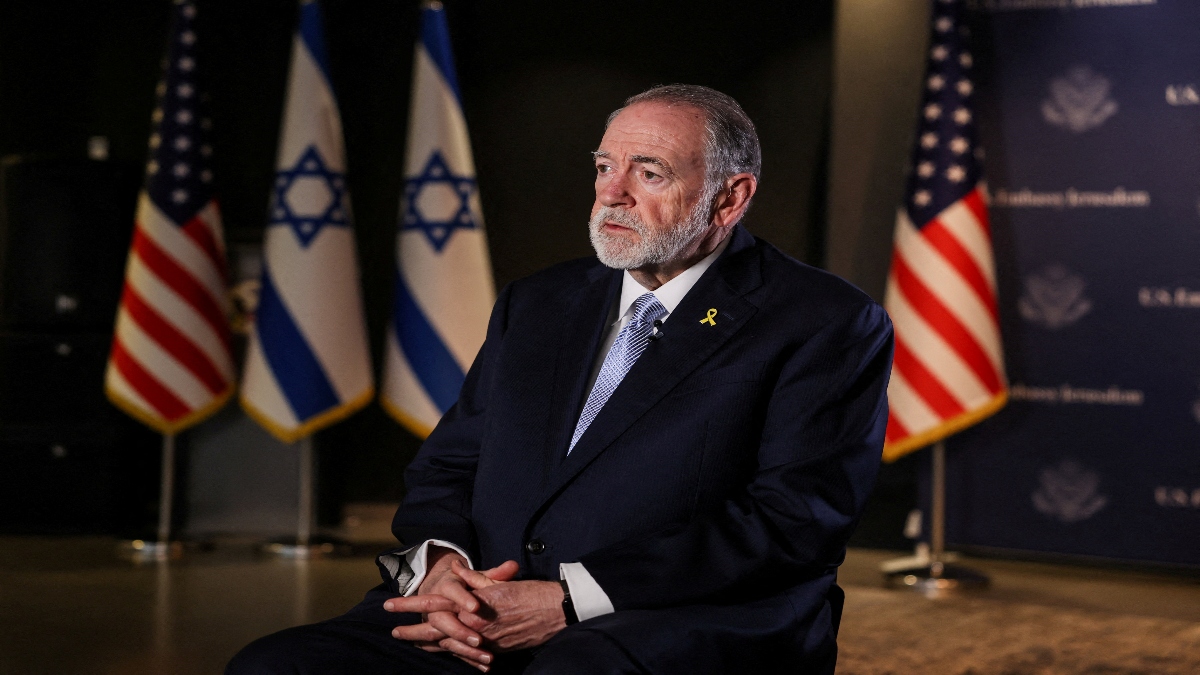
 "'Leave today’: US Ambassador to Israel sends urgent message to mission staff as possible Iran strike looms")
The US Embassy in Israel has advised non-essential personnel and their families to leave the country immediately amid escalating regional tensions and the possibility of a US strike on Iran.
According to a New York Times report, in an mail sent to mission staff on Friday, US Ambassador to Israel Mike Huckabee said the directive came after “meetings and phone calls through the night” and was issued out of “an abundance of caution” following consultations with the State Department, which prioritised staff safety.
Those wishing to depart “should do so TODAY,” he wrote, urging employees to secure flights from Ben-Gurion Airport to any destination from which they could continue travel to Washington, D.C.
“The first priority will be getting expeditiously out of country,” he was quoted as writing in the mail.
“There is no need to panic, but for those desiring to leave, it’s important to make plans to depart sooner rather than later,” he added.
Huckabee cautioned that while more outbound flights may become available in the coming days, there was no guarantee.
Already, KLM, the Dutch airline, has suspended service to Israel, citing “commercial and operational considerations.”
The ambassador also confirmed the embassy had shifted to an “authorised departure” status as of 10 am Friday, allowing non-essential staff and dependents to evacuate at government expense when “US national interests or imminent threat to life requires it,” according to State Department regulations.
Quick Reads
View AllHe scheduled a town-hall meeting at 12:30 pm to provide additional information.
In a separate advisory issued by the US embassy in Jerusalem, the embassy said it may further restrict or prohibit US government employees and their family members from traveling to certain areas of Israel, the Old City of Jerusalem, and the West Bank.
Americans are advised not to travel to Gaza and northern Israel near the Lebanese and Syrian borders, while travel to the West Bank should be reconsidered due to ongoing security risks, said the advisory, warning that violent incidents can occur with little or no warning, targeting public areas such as markets, transportation hubs, and tourist sites.
“US citizens traveling in the region are urged to stay alert, avoid crowds and demonstrations, follow instructions from local authorities, and maintain contingency plans for emergencies. Those in Gaza should prepare for extended stays due to possible border closures, and US consular assistance in the area is extremely limited,” the advisory read.
The advisory comes as negotiations between the United States and Iran over Tehran’s nuclear programme continue without a clear breakthrough, and as Washington has increased its military presence in West Asia.
Military action imminent?
According to an Economic Times report, the risk of a US strike on Iran has surged to a critical level, highlighted by a sharp reduction in staffing at the US Fifth Fleet headquarters in Bahrain, now reportedly limited to fewer than 100 mission‑essential personnel, a move seen as part of preparations for possible military action.
This drawdown, along with satellite imagery showing US warships leaving Bahrain’s ports, suggests a shift toward a high‑readiness combat posture, added the report.
The escalation follows the collapse of the third round of nuclear talks in Geneva on Thursday, pushing US strategy into what analysts describe as a “maximum pressure” phase.
On February 24, twelve F‑22 fighter jets were deployed to Ovda Airbase in southern Israel — the first US deployment of offensive aircraft on Israeli soil — after Gulf allies including Saudi Arabia, Qatar and the UAE reportedly refused to host strikes on Iran. Israel has emerged as the fallback option for basing.
By Thursday (February 26), the USS Gerald R. Ford had departed Souda Bay in Crete to join the USS Abraham Lincoln carrier strike group near Israel. Having two carrier strike groups in the same theatre is exceptionally rare and is widely interpreted as a sign of imminent military action rather than routine deterrence, reported Economic Times
Iran has warned it could retaliate against US bases and allies such as Israel should conflict break out.
US-Iran nuclear talks
The United States and Iran made “significant progress” in a third round of nuclear talks in Geneva on Thursday, mediator Oman said, though prospects for a deal remain uncertain.
Iranian Foreign Minister Abbas Araghchi, who led Tehran’s delegation, called the negotiations among the “most intense and longest” so far.
He said “good progress” was achieved with agreements on some issues, but key differences persist. The next round is expected within a week.
Iranian state media said Tehran reaffirmed its right to peaceful nuclear energy and rejected US demands to fully halt uranium enrichment or transfer its 400kg stockpile abroad.
Meanwhile on Friday, Iran urged Washington to abandon what it called “excessive demands” over its missile programme, after a Wall Street Journal report said the US may seek the dismantling of three major nuclear sites and the handover of all enriched uranium.
In talks with his Egyptian counterpart, Araghchi said progress requires “seriousness and realism” from the US, warning against miscalculations and maximalist positions.
With inputs from agencies

 "Iran War News Live: Azerbaijan withdraws envoys from Iran after drone strike on its airport")
 "'Hopeful not confident': Finnish President on a peace deal between Russia and Ukraine")
 "Decision to attack Iran taken after Modi had left the shores, says Israeli foreign minister")
 "Why US has given India a 30-day waiver to buy Russian oil")
 "Iran War News Live: Azerbaijan withdraws envoys from Iran after drone strike on its airport")
 "'Hopeful not confident': Finnish President on a peace deal between Russia and Ukraine")
 "Decision to attack Iran taken after Modi had left the shores, says Israeli foreign minister")
 "Why US has given India a 30-day waiver to buy Russian oil")