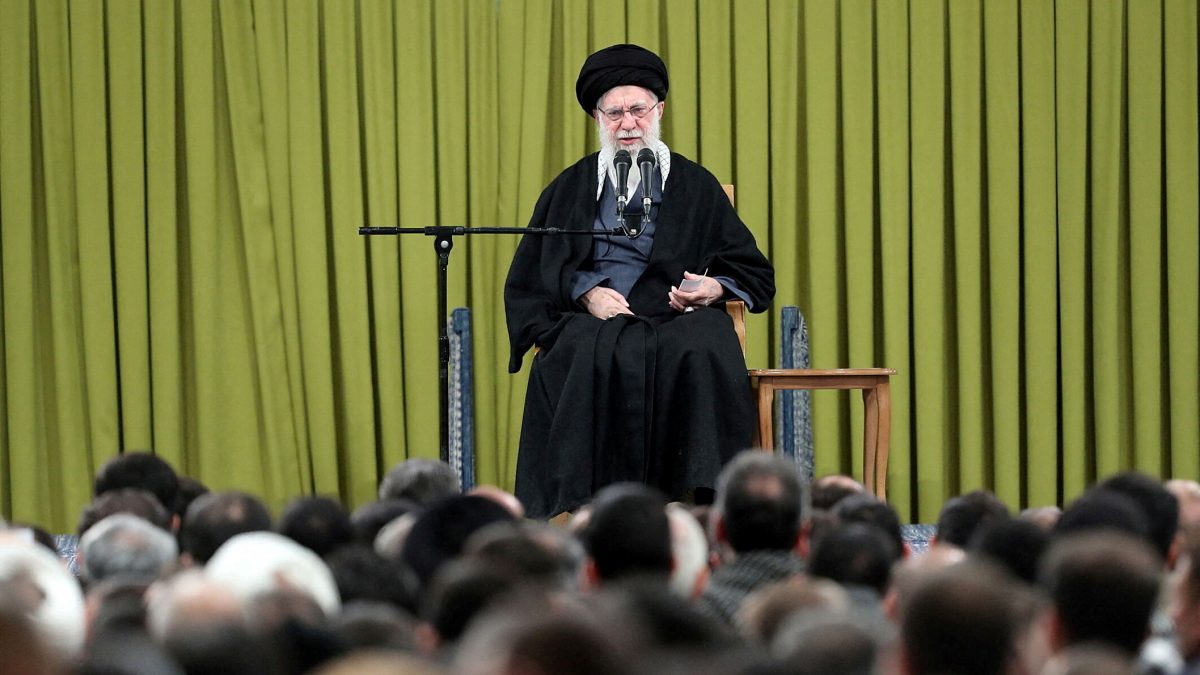
 "Iran reinforces entrances at Pickaxe Mountain amid US tensions. Why does this matter?")
Satellite images show that Iran is fortifying an underground complex near one of its nuclear facilities.
The development comes amid tensions between Tehran and Washington, with President Donald Trump threatening military strikes on Iran unless a deal can be reached over the nuclear programme.
The site, known as Pickaxe Mountain, has been off-limits for nuclear inspectors. The development comes seven months after the United States conducted strikes on Iran’s nuclear facilities, including the one at Natanz.
Trump had claimed that Iran’s facilities had been completely wiped out and ‘obliterated’, an assessment undercut by his own intelligence agencies.
Trump has threatened strikes on Iran if no agreement is reached, while Tehran has vowed to retaliate, stoking fears of a wider war as the US amasses forces in West Asia. He has repeatedly voiced support for a secure Israel, a longstanding US ally and arch-foe of Iran.
But what do we know about these new fortifications? What do they mean?
Let’s take a closer look.
What we know about the new fortifications
As per the BBC, satellite images show tunnel entrances being reinforced at Mount Kolang Gaz La, also known as Pickaxe Mountain.
The site is in central Iran near the peak of the Zagros Mountains, around 1.6 kilometres south of Natanz, Iran’s main uranium enrichment facility, according to ABC.net.
The photos were analysed by the Institute for Science and International Security (ISIS), a US-based think tank. ISIS is headed by David Albright, a leading American physicist and nuclear weapons expert, who is also a former weapons inspector.
As per the BBC, a satellite image from February 10 shows what seemingly looks like fresh concrete on top of one of the entrances to Pickaxe Mountain. A boom pump used to deliver concrete is also at the location, analysts from both ISIS and UK-based intelligence analysis firm Maiar have said.
That’s not all. Rock and soil have also been pushed back and flattened at another tunnel entrance. A new concrete-reinforced structure has been put up close by.
Spencer Faragasso, a senior research fellow at the US Institute for Science and International Security, told ABC.net his team had begun monitoring the mountain in 2020. Satellite imagery shows Pickaxe Mountain could be a “potential candidate” for new uranium enrichment activities.
According to PBS, Tehran has said its goal is for Pickaxe Mountain to be home to a production plant for assembling centrifuges. The Iranian government also denies that it is pursuing a nuclear weapon. It says its nuclear programme is for peaceful means.
What this could mean
Why this matters?
Experts say it is possible that Iran is trying to guard against a potential airstrike.Pickaxe Mountain was not targeted when Natanz and two other key Iranian nuclear facilities, Fordow and Isfahan, were targeted in strikes by the United States. ISIS, in a November report, claimed that “overall, the damage caused by airstrikes to numerous nuclear sites was extensive and, in many cases, catastrophic”.
The tunnels of Pickaxe Mountain are thought to be concealed between 79 and 100 metres into the earth, possibly deeper than the Fordow facility, which is “raising significant concern” with experts.
“In the past, Iran has tied the construction to rebuilding an advanced centrifuge assembly plant, but the size of the facility, as well as the protection provided by the tall mountain, raised immediate concern that additional sensitive activities are planned, such as uranium enrichment,” experts at Isis were quoted as saying by the BBC.
“We don’t have internal schematics to really judge what the inside will look like,” Faragasso told ABC.net. “But given the size of the spoil piles, the amount of construction they’re doing, it wouldn’t be incomprehensible to see them establish an enrichment facility inside it.”
The amount of the work shows it could be “a potential candidate site for any Iranian reconstitution of its centrifuge programme, from component production to assembly to enrichment,” ISIS has said in its analysis.
Other agree.
“The ability for the regime to reconstruct centrifuges is going to be important for their ability to bounce back, which puts more eyes on Pickaxe,” Jarrett Ley of The Washington Post told PBS. “And if indeed there is centrifuge construction taking place there, what that means is that they’ll be able to come back relatively quickly.”
Iran has refused to say what work is ongoing at Pickaxe Mountain. Asked by IAEA director-general Rafael Grossi, Tehran reportedly responded, “It’s none of your business.”
According to PBS, Sebastian Walker, correspondent and producer of Strike on Iran: The Nuclear Question, asked Ali Larijani, secretary of Iran’s Supreme National Security Council, about the site.
“There’s a site south of Natanz where international observers have seen new reinforcements of the entrance,” Walker said. “There’s been some activity noticed there — it’s known as Pickaxe Mountain. Is there new activity that these strikes have created? Is there anything you can tell us about that site?”
Larijani responded, “No, nothing; we haven’t abandoned any of those locations. But in the future they could possibly continue to run as they do currently or be shut down.”
Experts say these developments show why the IAEA is critical.
“This is why the IAEA needs to be able to do its job and Iran needs to come clean about what it’s doing and provide a complete and full declaration of its activities, especially at the Pickaxe Mountain site,” Faragasso said.
With inputs from agencies

 "India, Israel elevate ties to special strategic partnership; PM Modi calls it ‘reflection of aspirations of both nations’")
 "India vs Zimbabwe LIVE Score, T20 World Cup 2026: Abhishek, Kishan take over at Chepauk after Samson's cameo")
 "Who is Borge Brende, World Economic Forum chief who quit over Epstein files?")
 "US-Iran tension: Third round of nuclear talks begin in Geneva — can it avoid war?")
 "India, Israel elevate ties to special strategic partnership; PM Modi calls it ‘reflection of aspirations of both nations’")
 "India vs Zimbabwe LIVE Score, T20 World Cup 2026: Abhishek, Kishan take over at Chepauk after Samson's cameo")
 "Who is Borge Brende, World Economic Forum chief who quit over Epstein files?")
 "US-Iran tension: Third round of nuclear talks begin in Geneva — can it avoid war?")